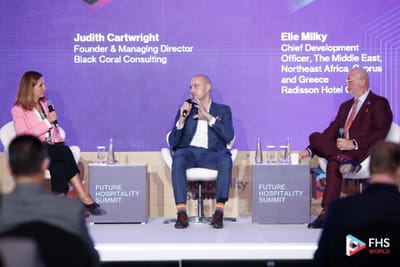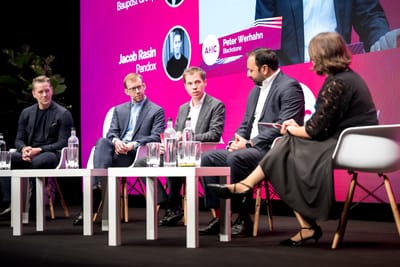

At Future Hospitality Summit (FHS) Dubai 2025, branded residences were no longer treated as a marketing add-on to hotels. Across Jeff Tisdall’s global “state of the industry” keynote, operational panels and investor discussions, the message was clear: this is now a scaled, system business, with its own data, talent, legal structures and capital flows.
For investors, lenders and developers, that shift has real consequences for how deals are underwritten, structured and operated.
From niche curiosity to global system business
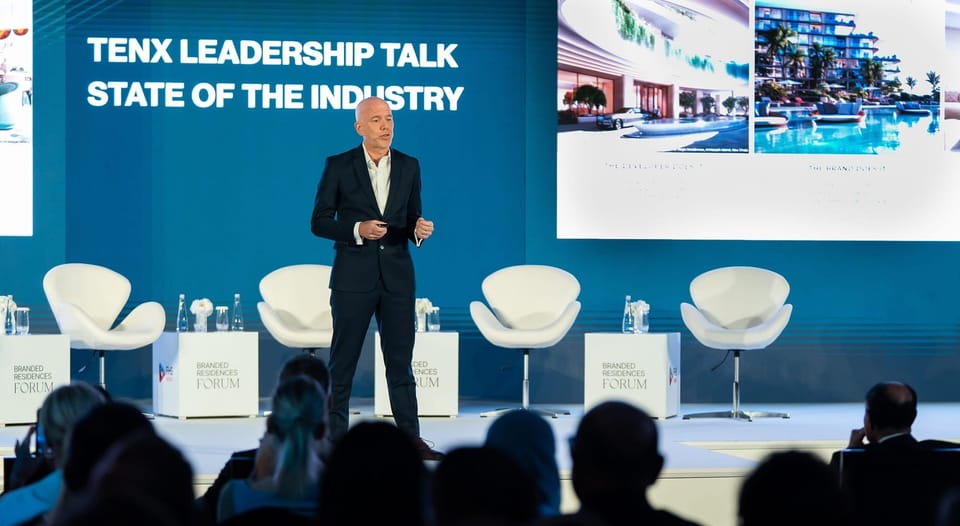
Jeff Tisdall, Chief Business Officer and Global Head of Mixed-Use at Accor One Living, opened the “State of the Industry” session with a simple framing:
“This is a space that has absolutely gone from niche 15-20 years ago… to truly mainstream, driving both hospitality and very significant parts of residential development around the world.”
Drawing on data from Global Branded Residences, Tisdall highlighted:
- 1,784 branded residential projects worldwide,
784 completed and just over 1,000 signed or announced. - Around 75% hospitality-branded, with the rest made up by design, F&B and automotive brands.
- A compound annual growth rate of around 13% over roughly two decades, with the business now in a second phase of expansion across EMEA and Asia Pacific.
On pricing, he noted that once outliers are stripped out, the average global brand premium sits at around 37%:
“We cleared the outliers to an adjusted average at 37%… The real driver of that premium going up is the geographical distribution. We have seen branded residences in locations we have not seen them before, where the quality of existing non-branded stock is generally quite unsophisticated.”
Geography: North America challenged, Dubai as “petri dish”
One of the more important messages for global capital is that North America’s dominance is being eroded.
On existing stock, North America still accounts for roughly 34% of completed schemes, followed by Asia Pacific, with Europe, MENA and CALA in the “mid-teens”. But once you include the pipeline, the picture changes. Tisdall described a “levelling of the playing field”:
“When we look into the future… North America has gone from 34% to 20%, and MENA, CALA, Asia Pacific and Europe are all growing in terms of their market share.”
At a country level, the UAE now sits second behind the US on combined completed plus pipeline schemes, driven almost entirely by Dubai.
At city level, the familiar trio of Dubai, Miami and New York top the league table, but Dubai is now in a category of its own:
“Dubai continues to lead the way… In terms of cities… Dubai, Miami and New York [are] first, second and third globally… Looking at supply, both operating and in the pipeline, Dubai is now nearly twice the size of Miami.”
He described Dubai as:
“An unofficial petri dish of the global branded sector… we are seeing a really accelerated level of growth, around 132% in the next five to six years.”
For anyone underwriting branded residence exposure, that makes Dubai both a leading indicator and a stress test for typologies, legal frameworks and operating models that may later be exported to London, Paris, Miami or secondary European cities.
Product reality: “not just hotels with keys”
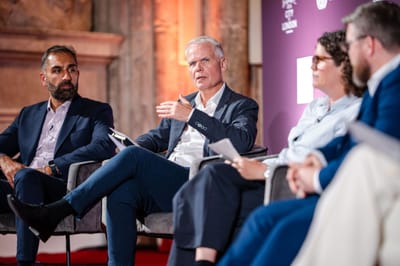
FHS devoted a full panel, “The Misconception Myth: Why Branded Residences Aren’t Just Hotels with Keys”, to unpacking what makes these schemes structurally different from hotels.
The discussion brought together Melisa Pezuk (AMAALA, Red Sea Global), Dean Main (Founding Partner & CEO, Rhodium Residence Management), Chris Graham (Graham Associates) and Govind Mundra (Wyndham).
Three points stood out:
- Long-term ownership vs short-term stay
Branded residences are primarily home-ownership products, often holding a significant share of an UHNW buyer’s wealth. Buyers expect hotel-grade service, privacy, governance and capex discipline over decades. - Operational depth matters more than logo
Over the last decade, the number of non-hospitality brands in the sector has jumped from seven to more than 75, including fashion and automotive labels. Dean Main’s contribution, coming from a pure residence-management platform, was essentially: launch-day sales are not the test; year 15 service quality and building governance are. If the brand cannot sustain its promise through reserve-fund planning, defect management and day-to-day community operations, the premium erodes quickly. - Trust is the core product
“We want buyers and people with the capitalisation of these projects to trust the team, to trust the brand… A lot of branded residential buyers invest in multiple products because they really believe in that brand promise. So much of that has to do with the way it’s marketed… and the way it’s being managed.”
For capital providers, this is effectively a governance and operator-selection problem: which brands and managers can actually sustain hotel-grade service, community management and capex discipline over 20 to 30 years?
Standalone branded residences: Wyndham’s Dubai test case
One of the biggest structural shifts highlighted across several sessions was the rise of standalone branded residences, meaning schemes without an on-site hotel.
In the “Misconception Myth” discussion, Govind Mundra, Head of Development for Middle East & Africa at Wyndham Hotels & Resorts, used Dubai as a live case study. The company chose the emirate as its test market for standalone branded residences, in part because the RERA framework gives a relatively clear set of rules for owners’ associations and escrow.
“We started our standalone journey, and particularly in Dubai, because the whole RERA system announced the rules and regulations… We started our journey almost a year back, where we looked at what are the current operations in the market, what are the other brands doing? We called a [law] firm to help us structure that from a legal point of view.”
Wyndham has now launched a Ramada Residences scheme in Jumeirah Village Circle and, as Mundra put it, has “nine agreements under negotiation” across JVC, JVT, Dubai Islands, Dubai South and Marjan in Ras Al Khaimah.
Tisdall’s data suggests why that matters. In Dubai today, around a third of stock is already standalone, and somewhere between 70% and 90% of the pipeline is standalone. That implies this becomes the dominant typology in the city over the next cycle.
For investors, that shifts the risk profile. There is no hotel P&L to subsidise services, there is more direct reliance on service charges and a la carte revenues, and there is greater exposure to owners’ association dynamics.
Key takeaways for investors and developers
- From niche to system business
Branded residences have grown at around 13% per year over two decades and now number more than 1,700 projects worldwide. They should be treated as a core asset class, not a marketing bolt-on. - Premium is real but fragile
The average global price premium of about 37% depends on long-term operational performance and governance, not just the logo on the door. - Dubai is the global laboratory
Dubai has almost twice as many branded residence projects (operating plus pipeline) as Miami, and is testing new typologies, especially standalone. What works here is likely to be exported into other markets. - Operations and governance are the real moat
Panels led by operators like Dean Main made it clear that residence management, HOA relations and long-term capex discipline will separate durable brands from “logo only” plays. - Standalone schemes change the risk profile
Wyndham’s Dubai strategy shows how standalone branded residences require new legal structures, oversight teams and revenue models, but also open up new development sites where a full hotel may not work.
As Tisdall put it at the end of his keynote:
“As dynamic and exciting as the last 10 years have been, the best is really ahead of us.”
Subscribe to our newsletter.
Become a subscriber receive the latest updates in your inbox.