
The short-term rental sector has spent much of the past decade defining itself against hotels. At Short Stay Summit 2026, however, the more urgent question was whether that distinction still matters.
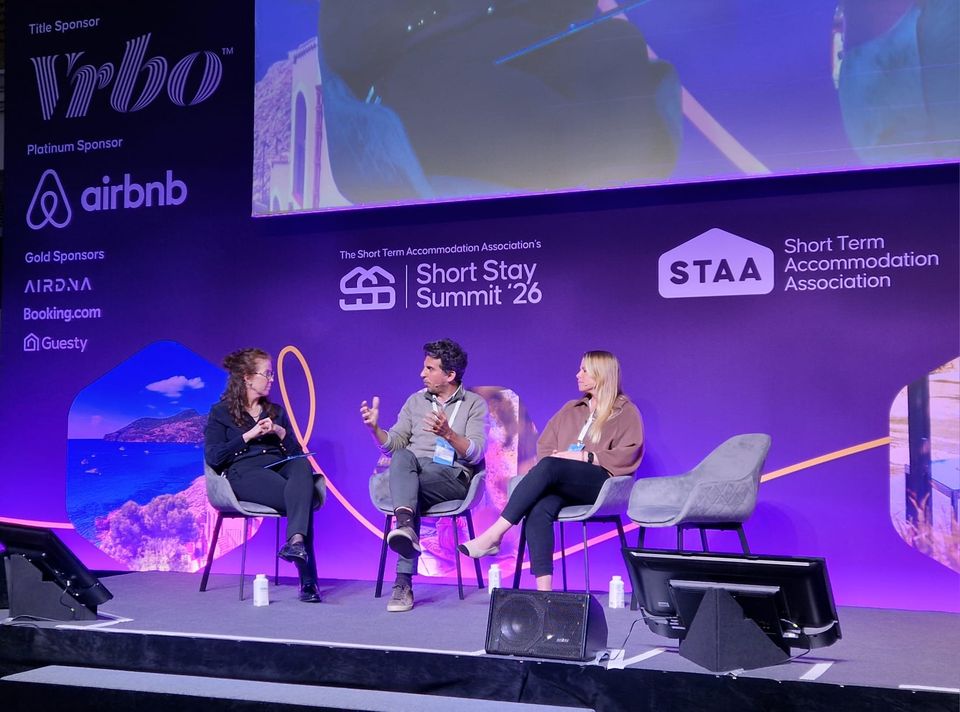
In the session “Beyond booking: Reimagining the future of flexible living”, hosted by Jessica Gillingham, Founder and CEO of Abode Worldwide, speakers Maxime Leufroy-Murat, CEO of City Relay / Opago / Leufroy, and Rebekah Tobias, Managing Partner at Propela Ventures, explored how flex lets, co-living, branded residences, serviced apartments, PBSA summer lets and PRS models are converging into a broader flexible living ecosystem.
From holiday lets to flexible living
For Leufroy-Murat, flexible living is not a single asset class. It is a way of managing residential assets around changing demand.
Rather than viewing a property as either a long-let, short-let or serviced apartment, he argued that owners are increasingly asking how an asset should perform across different lengths of stay, seasons and customer groups. The objective is yield optimisation, but the mechanism is operational flexibility.
That shift reflects a deeper change in consumer behaviour. Residents and guests increasingly expect turnkey living: furnished homes, utilities included, digital support, reliable service and a sense of community. In Leufroy-Murat’s words, people increasingly want to “be guests where we live” — not necessarily in the sense of transient hotel stays, but in the expectation that the friction of living should be removed.
“We want to be guests where we live.”
— Maxime Leufroy-Murat
Tobias described a similar evolution from the investor side. Her first exposure to flexible living came through backing a co-living platform in London six or seven years ago, when lenders were still struggling to understand how to finance the product. Questions around planning, use class, tenure and valuation made the sector difficult to underwrite.
That has changed. Co-living and flexible residential models are now becoming more institutionalised, with more comparable transactions, more purpose-built schemes and growing capital interest across Europe.
Flexibility can create income security
One of the most counterintuitive points from the discussion was that shorter contractual flexibility can, in some cases, support longer actual occupancy.
Tobias recalled early co-living schemes offering minimum stays of around 90 days. Despite the apparent flexibility, average stays increased to around 12 to 15 months. The lesson was that residents valued optionality. By reducing commitment at the start, operators could increase loyalty over time.
That point matters for institutional investors. Flexible living is often perceived as less secure than traditional long-let income, but the panel argued that the right operating model can produce resilience through higher retention, better brand attachment and more responsive pricing.
The implication is that investors may need to move beyond binary assumptions about short-term versus long-term income. In an undersupplied housing market, flexibility itself can become a defensive characteristic — provided the asset is managed well.
Regulation may accelerate the shift
The UK’s rental reform agenda was a central part of the conversation. From 1 May 2026, the Renters’ Rights reforms are due to take effect in England, ending Section 21 “no-fault” evictions and moving most assured tenancies into a periodic tenancy regime. Landlords will only be able to end tenancies in specified circumstances, such as where the tenant is at fault or where the landlord needs to sell.
For Leufroy-Murat, this could push more landlords and investors to consider flexible models. If traditional PRS becomes harder to manage in the way some landlords are used to, professionally operated flexible living may become more attractive.
Tobias went further, suggesting that institutional PRS and build-to-rent owners are already thinking about what proportion of their portfolios could be switched into shorter-stay or flexible formats. Today, that might be a minority of stock. Over time, she argued, the percentage could rise materially as owners adapt to new rules, changing tenant behaviour and the need for more sophisticated revenue management.
But the shift will not happen overnight. Real estate capital is slow-moving, and short-stay operations require different systems, distribution strategies and operational expertise from conventional rental management.
The operator becomes the investment case
The panel repeatedly returned to one point: flexible living is not passive real estate.
Short-stay and flexible residential models are operationally intensive. They require dynamic pricing, digital infrastructure, guest and resident communications, housekeeping, maintenance, compliance, community programming and channel management. For investors used to collecting rent under long leases, that is a fundamentally different business.
Tobias argued that many institutional investors still underestimate this distinction. Property management, she said, is not the same as experience management. Rent collection and service charge administration do not create the lifestyle, trust, safety, community or brand recognition that make people choose one building over another.
“Property management is rent collection. It’s service charge collection. That has nothing to do with what the tenant experiences day to day coming in and out of that building.”
— Rebekah Tobias
That is why operator selection is becoming central to investment strategy. The best operators are not simply managing buildings; they are creating brands that stand for a specific resident experience.
Leufroy-Murat made a similar point from the platform side. His businesses have moved toward vertical integration across investment, development and operations because investors want confidence in execution. In a market where office-to-residential conversions, C1 use, PRS blocks and flex models are being explored, capital needs partners that can source, deliver and operate the product.
Branding moves into PRS
One of the clearest opportunities identified was the branding of private rented residential stock.
Leufroy-Murat noted that while hospitality and build-to-rent have developed recognisable brands, much of the PRS market remains unbranded. Renters often do not know what quality of apartment, service or experience they will receive until they move in.
“There’s a huge gap in the market to start branding in the PRS sector.”
— Maxime Leufroy-Murat
His new platform, Sejour, is designed to address that gap by aggregating refurbished units under a branded proposition. The aim is to bring consistency, community and a clearer customer promise to a fragmented rental market.
That strategy reflects a wider trend. In hotels, brand has long been a shorthand for trust. In flexible living, brand may increasingly perform the same function: reducing uncertainty for residents, supporting direct demand and allowing operators to compete beyond commoditised listing platforms.
Hospitality is no longer confined to hotels
The session’s most important conclusion was that the boundary between hospitality and real estate is dissolving.
Tobias argued that hospitality is now infiltrating every part of the built environment. Office buildings have cafés, concierge desks and hotel-style receptions. Student housing, co-living and build-to-rent schemes are being designed around service, community and experience.
The first 30 seconds of arrival — once mainly a hotel concern — now shape perceptions of residential and workplace assets too.
“The first interaction that you have when you walk into a hotel or, now, student living or co-living building, that first 30-second interaction actually frames your entire stay.”
— Rebekah Tobias
Leufroy-Murat linked this to rising customer expectations. Whether someone is staying for two nights, three months or two years, they increasingly expect responsiveness, ease and quality of service. That does not make every residential asset a hotel, but it does mean that hospitality skills are becoming essential to residential performance.
A new sector identity
The panel did not settle on whether flexible living belongs to hospitality, real estate or short-term rentals. Instead, it suggested that the most successful companies will be those comfortable operating across all three.
For short-stay businesses, that creates both opportunity and risk. More institutional capital could bring more supply, more professionalism and more partnership opportunities. But it could also raise the bar for technology, compliance, brand building and operational capability.
The sector’s evolution from holiday cottages and city apartments into a flexible living ecosystem is already underway. The next chapter will be defined by companies that understand assets like real estate, serve customers like hospitality businesses, and manage demand like sophisticated operating platforms.
Key takeaways
- Flexible living is no longer a niche category.
The panel positioned flexible living as a broad and fast-maturing ecosystem that now includes short stays, serviced apartments, co-living, branded residences, PRS, PBSA and hybrid models. - The sector is being shaped by both demand and regulation.
Consumers want convenience, flexibility and turnkey living, while rental reform may encourage more landlords and institutions to explore flexible operating models. - Institutional capital is interested, but still learning.
Investors are increasingly attracted to beds and living sectors, but many still underestimate the operational complexity of short-stay and flexible residential models. - Operators are becoming central to asset value.
The right operator can drive occupancy, retention, resident experience, brand perception and yield. Flexible living is not passive real estate; it is an operating business. - Brand will matter more in residential real estate.
As PRS and flexible living mature, branded propositions could help create trust, consistency and direct demand in a market that has historically been fragmented and largely unbranded. - Hospitality and real estate are converging.
The future of the sector will not be defined by whether a business is “hospitality” or “real estate”, but by whether it can combine real estate discipline with hospitality-level service and customer experience.
Subscribe to our newsletter.
Become a subscriber receive the latest updates in your inbox.