
Tokenization has spent years promising to rebuild finance. At Tokenize: LDN 2025, the more interesting question was whether finance actually wants to be rebuilt, or simply wants better rails.
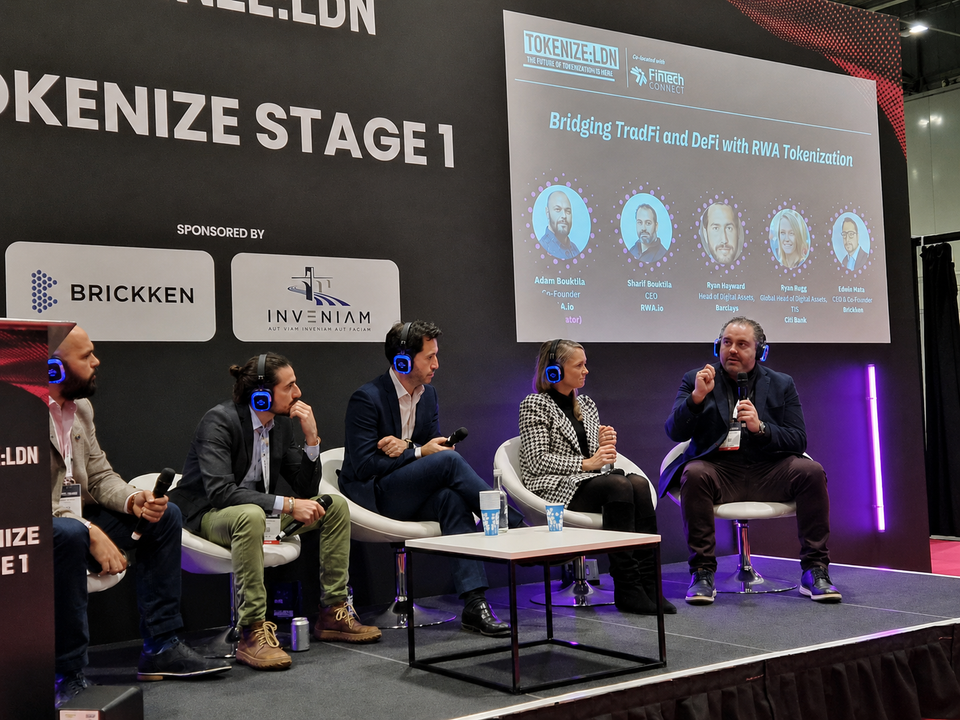
The panel “Bridging TradFi and DeFi with RWA Tokenization” brought together Adam Bouktila, Co-founder of RWA.io, Sharif Bouktila, CEO of RWA.io, Ryan Hayward, Head of Digital Assets at Barclays, Ryan Rugg, Global Head of Digital Assets, TTS at Citi Bank, and Edwin Mata, CEO and Co-founder of Brickken.
The subject was broad: how traditional finance and decentralized finance might converge through real-world asset tokenization. The mood was more grounded.
The room itself told part of the story. When the audience was asked who had used a DeFi protocol, a few hands went up. When asked who had held a tokenized real-world asset, far fewer did.
Even at a tokenization conference, adoption remains early.
That gap between narrative and usage shaped the whole discussion. Tokenization is no longer a theoretical exercise, but it is not yet a liquid, widely used market either. The panel’s real value was in explaining why.
The bridge is real, but it is still under construction
The panel broadly agreed that bridging TradFi and DeFi is realistic. But the bridge will not be built by technology alone.
Much of the technical stack already exists. Issuers can access APIs, white-label applications, onboarding workflows, KYC, KYB, AML, reporting and token issuance infrastructure.
The harder problem is confidence.
For institutions, tokenization is not simply about creating a digital version of an asset. It is about knowing what that token represents, how it is priced, how it is reported, who holds custody, what legal rights investors have and what happens if something goes wrong.
That is especially important with real-world assets. A tokenized fund, property interest or debt instrument still depends on off-chain reality. The asset has to exist, the legal rights have to be enforceable and the data has to be trusted.
Tokenization does not remove the need for trust.
It moves the trust problem somewhere else.
Banks are not trying to abolish themselves
One of the clearest shifts in the discussion was how the banks talked about blockchain.
The early crypto narrative was about removing intermediaries. The institutional version is much more pragmatic.
Ryan Rugg said Citi treats blockchain as another set of rails. If clients want to use stablecoins, tokenized deposits or blockchain-based infrastructure, the bank wants to support those rails where they solve real problems.
That is a very different proposition from DeFi replacing TradFi.
Large banks already process huge volumes through existing systems. They also carry regulatory obligations, reporting requirements, risk controls and client expectations that cannot simply be paused while new infrastructure is tested.
Ryan Hayward made the same point from the Barclays perspective. Banks cannot move everything into a new digital asset environment overnight. They have to connect new technology to existing liquidity, reporting, settlement and risk infrastructure.
That makes adoption slower, but more durable.
The question is not whether everything should move on chain. The question is where moving on chain creates enough value to justify the operational change.
The best blockchain experience may be one users barely notice
The panel kept returning to user experience because this is where many tokenization projects still fall short.
For tokenization to scale, investors and corporate clients cannot be expected to manage wallets, keys, nodes and blockchain infrastructure themselves. The technology has to disappear into the background.
“If people don’t say, ‘we’re using blockchain,’ the more successful it is.”
That line captured the institutional challenge neatly.
A treasurer moving liquidity across time zones should not need to think about which blockchain is being used. A fund investor should not need to understand smart contract architecture. A corporate client should not need to manage private keys to benefit from faster settlement.
The utility has to be accessible through familiar systems.
Sharif Bouktila put the buy-side point more directly. The user experience needs to improve, but so does the pricing. Investors need a reason to buy the tokenized version of an asset rather than the traditional one.
That reason might be lower cost, faster settlement, better access, improved collateral use or a new product structure.
But tokenization alone is not enough.
A weak product does not become a strong product because it is put on chain.
Liquidity is not created by pressing “tokenize”
The most important theme of the discussion was liquidity.
Tokenization can make an asset easier to transfer, record and distribute. It does not automatically mean there will be a buyer on the other side.
That is one of the market’s most persistent misconceptions.
Many tokenized assets can be issued. The harder part is building a secondary market where investors can actually trade them. This is particularly difficult in real estate, private markets and smaller security offerings, where the underlying assets are already illiquid.
The panel described a familiar circular problem.
Issuers want to see liquidity before committing fully to tokenization. Investors want deeper markets before committing capital. Institutions want proof of demand before upgrading systems. Demand is hard to prove until the products, infrastructure and market structure improve.
This is why some of the strongest early use cases are not the most glamorous ones.
Money market funds, tokenized deposits, payments, bonds, private credit and collateral mobility may scale faster because the demand is clearer and the operational benefits are easier to measure.
Liquidity is not a feature that appears after tokenization. It has to be designed into the product, the distribution and the market structure.
The most convincing use cases are financial plumbing
The strongest institutional examples in the discussion were not about speculative trading. They were about treasury, payments and liquidity management.
Rugg described Citi Token Services as a response to client demand for real-time liquidity and funding. Large corporates operate across time zones, currencies, subsidiaries, suppliers and bank holidays. In the traditional system, they often need to forecast where money will be needed and pre-position liquidity in advance.
That creates inefficiency.
Rugg gave the example of a broker-dealer in Singapore that needed to buy US equities and meet margin calls during Chinese New Year. Traditionally, it would have had to estimate its funding needs and park money in advance. With tokenized deposit infrastructure, the transfer could happen in under a minute.
That is not an abstract blockchain use case. It is a practical treasury problem.
Hayward added that banks face similar issues with intraday liquidity, FX mismatches and collateral movement. Large institutions have capital and liquidity tied up across currencies, clearing houses and operational processes. Moving assets and money more efficiently during the day could create meaningful savings.
This is where tokenization stops looking like a buzzword and starts looking like financial plumbing.
And financial plumbing matters.
The integration problem is bigger than the token problem
Issuing a token is often the easy part. Making it work inside institutional finance is harder.
Banks and large corporates rely on ERP systems, treasury systems, accounting processes, settlement windows, reporting obligations and strict change-control procedures.
Blockchain networks may run 24/7, but many institutional systems do not.
A tokenized payment may move in real time, while the receiving company still reconciles transactions at the end of the day. A blockchain rail may operate through a bank holiday, while a treasury system remains built around batch settlement.
This is why tokenization is not just a technology project. It is a change-management project.
Institutions need infrastructure that can handle always-on finance. Clients need systems that can process real-time movement of money and assets. Risk teams need new controls. Legal teams need new documentation. Finance teams need new accounting processes.
That is why the panel was cautious about the idea of a fully tokenized capital markets stack emerging quickly.
Targeted improvements in payments, treasury, collateral and post-trade processes are much closer.
The bridge between TradFi and DeFi may arrive as a series of practical upgrades rather than one dramatic migration.
Standards will decide whether the market scales or fragments
As more tokenized assets come to market, standards become more important.
Without common standards, every issuance risks becoming a bespoke project. That creates friction for issuers, investors, banks, exchanges and custodians.
Brickken has been involved in developing a more flexible standard for real-world assets, described during the session as a universal RWA approach. The argument is that tokenized assets are not all the same. A property interest, fund interest, debt instrument and equity-like security may each require different functions.
A rigid standard may not work across all of them.
The goal is modularity: issuers should be able to use the functions they need while still benefiting from interoperability.
For banks, this matters because infrastructure decisions are expensive and long term. Hayward noted that large institutions are wary of multi-year builds where the target keeps moving. If a bank builds around one approach and the market standard shifts, the cost of re-engineering can be significant.
Standards are not a technical detail.
They are one of the conditions for institutional confidence.
Real estate is the obvious use case, but not the easiest one
Real estate is often the first example people mention when discussing tokenization. It is tangible, valuable and familiar. Fractional access to property is easy to understand.
But the panel warned against assuming it is simple.
The first question is what exactly is being tokenized.
Is it direct ownership of a property? Shares in an SPV? Economic rights? A debt claim? A fund interest? A REIT-like structure?
Each answer creates different legal, regulatory, tax and liquidity implications.
Then comes the secondary market problem. If investors buy into a tokenized property structure, can they sell later? Who provides liquidity? How is pricing determined? What happens in a stressed market?
The panel did not dismiss real estate tokenization. It suggested that the asset class may develop through more structured products: funds, REIT-style vehicles, index products and professionally managed investment structures.
In other words, the future of tokenized real estate may be less about slicing up individual buildings and more about creating better digital access to institutional-grade property exposure.
That is less flashy, but more credible.
Regulation could be the accelerator
Regulation will shape the pace of adoption.
Institutions need clarity on how tokenized assets are classified, how custody works, how settlement is treated, how public blockchain infrastructure can be used and how tokenized assets interact with existing securities law.
The panel touched on US legislative developments, including the GENIUS Act and wider market structure debates. The point was not that one piece of legislation will solve everything, but that clearer rules could allow more liquidity and more institutional products to move on chain.
Europe presents a different challenge. Legal frameworks exist for securities, but issuance can still be slow, expensive and fragmented. Some jurisdictions have created routes for tokenizing certain rights or corporate structures, but there is still no simple universal path.
The market does not need regulation to disappear.
It needs regulation that gives institutions enough certainty to build.
Risk management has to become legible
An audience question raised a key point: is tokenization under-traded because the risk management layer is still immature?
The answer was partly yes.
Traditional finance has established systems for rating, evaluating, custodying and distributing assets. Credit ratings, broker-dealer networks, custodians, fund administrators, risk models and investor suitability frameworks all help capital move through the system.
Tokenized assets need equivalent infrastructure.
Investors are not only assessing the underlying asset. They also need to understand smart contract risk, custody risk, key management risk, operational risk, legal enforceability and secondary market risk.
That is a lot to underwrite.
Some firms are beginning to build ratings and analytics for tokenized assets, but the market is still young. Until these frameworks mature, many institutions will remain cautious.
Trust has to be made legible to institutional investors.
The market is moving from proof-of-concept to implementation
A recurring theme was fatigue with proof-of-concepts.
Many people in the digital asset industry have spent years building pilots, demos and experiments. The panel suggested that the next phase is different.
Rugg said Citi’s approach is client-led. The bank is not using blockchain because it is fashionable. It is using it where clients have specific pain points, such as real-time liquidity and 24/7 money movement.
The early blockchain industry was often described as a hammer looking for a nail. Now, the better projects are starting with the nail.
Hayward said 2025 feels like a more serious year for institutional engagement. Banks, exchanges and financial market infrastructure providers are paying closer attention. The conversation has moved from whether the technology can work to where it should be used.
Over the next 12 to 24 months, the biggest progress is likely to come in specific areas where the benefits are measurable: payments, treasury, collateral, tokenized deposits, money market funds, bonds and selected private market products.
The future may be tokenized, but the route there will be practical rather than ideological.
Tokenization is not the product
The strongest conclusion from the panel was also the simplest.
Tokenization is not the product.
The product is still the asset, the yield, the risk, the liquidity, the legal rights, the distribution and the user experience.
Investors do not buy something because it is tokenized. They buy it because it offers a better opportunity.
Issuers do not tokenize because the technology is interesting. They tokenize if it reduces cost, expands distribution, improves operations or unlocks capital.
Banks do not adopt blockchain because it is fashionable. They adopt it if it improves client service, liquidity, settlement, collateral or efficiency.
That is why the next phase of real-world asset tokenization will be judged less by how many assets are put on chain and more by whether those assets become easier to access, trade, finance and manage.
The bridge between TradFi and DeFi is being built.
But it will not look like a clean break from the old system. It will look like a gradual convergence of infrastructure, regulation, liquidity and product design.
The institutions are not trying to rebuild finance from scratch.
They are trying to make it work better.
Takeaways
- Tokenization is moving from experimentation to implementation.
After years of pilots and proof-of-concepts, the strongest use cases are now more client-led, practical and measurable. - Banks see blockchain as another set of financial rails, not a replacement for the existing system.
The focus is on improving payments, liquidity, collateral movement and settlement rather than rebuilding finance from scratch. - Liquidity remains the biggest barrier for tokenized real-world assets.
Putting an asset on chain does not automatically create demand, secondary trading or deeper markets. - Payments, treasury and collateral are likely to scale faster than full capital markets tokenization.
Real-time money movement, tokenized deposits and intraday liquidity solve clearer institutional pain points. - Tokenization is not the product.
The winning products will be those where tokenization improves access, cost, liquidity, settlement or operational efficiency.
Subscribe to our newsletter.
Become a subscriber receive the latest updates in your inbox.