
Tourism is often treated as a soft sector. At UKREiiF, the message from Cumbria was that it is anything but.
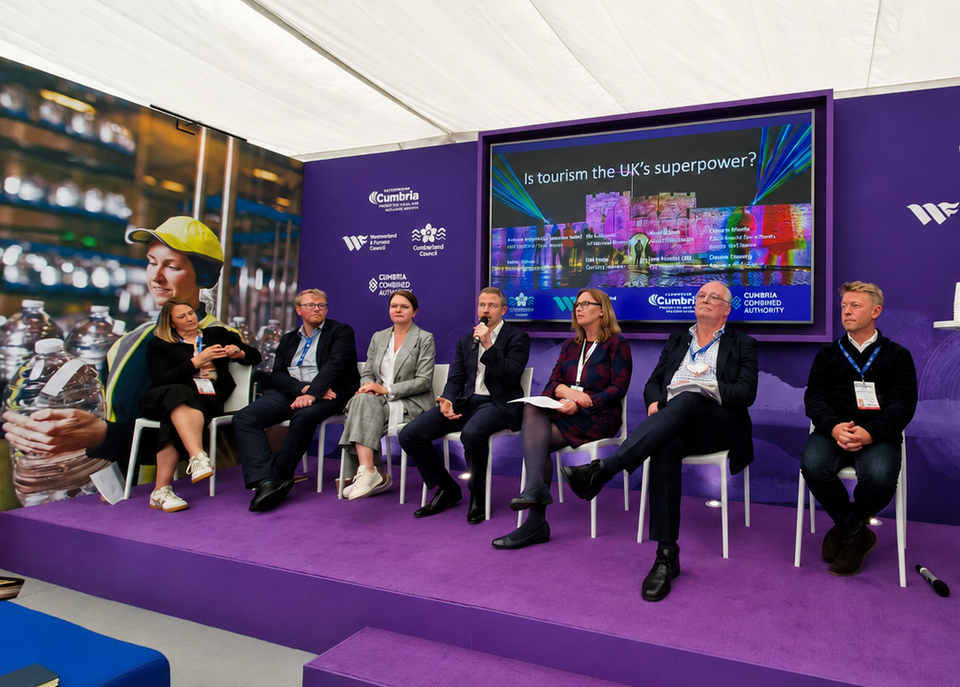
In the panel “Is Tourism the UK’s Superpower?”, speakers from VisitEngland, DCMS, UKHospitality, Cumbria Tourism, Whitbread Premier Inn, Forestry England, Ashall Projects and Cumberland Council explored how the visitor economy can drive regeneration, place shaping and long-term investment.
The discussion began with the scale of the sector. The UK visitor economy contributes more than £147bn to the economy and supports over 2 million jobs. But the panel’s central argument was that tourism’s value goes far beyond those numbers.
Tourism supports local identity, strengthens communities, brings footfall to high streets, underpins hospitality businesses and helps create places where people want to live, work, visit and invest.
For places like Cumbria, that makes tourism not just an economic sector, but a growth strategy.
Cumbria has a powerful brand, but a wider opportunity
Cumbria’s tourism story is often told through the Lake District. That brand is internationally recognised, but the panel argued that Cumbria’s opportunity is much broader.
Gill Haigh, Managing Director of Cumbria Tourism, said the county has a population of around half a million, but a visitor economy worth £4.6bn. Within that, food and drink contributes around £1.1bn, the supply chain around £1.2bn, and transport around £600m.
Her point was that tourism reaches deep into the local economy.
It is not only hotels, attractions and restaurants. It touches suppliers, transport operators, town centres, local producers, communities and employment.
“It’s hard to go anywhere in Cumbria and talk to somebody who isn’t touched by and involved in hospitality in some way, shape or form.”
Gill Haigh
Cumbria now has a shared destination management plan, embedded into the county’s economic strategy, local authority strategies and the emerging combined authority agenda.
That matters because the next phase of growth is not simply about attracting more visitors to the Lake District in peak season. It is about spreading value across the whole county and across the whole year.
Tourism needs to be treated as an economic ecosystem
For Duncan Parish, Deputy Director for the Visitor Economy at DCMS, the visitor economy is fundamentally place-based.
Every destination has different assets, gaps and ambitions. Nationally, the UK wants to capture more international growth. Locally, the question is what kind of visitor economy each place wants to build.
That means destination plans need to move from ambition to investment.
For Cumbria, the challenge is to define where the gaps are, which markets it wants to attract, what visitor offer it wants to create, and what support is needed to deliver that.
Parish said government is looking at visitor economy growth through that local and regional lens, particularly as combined authorities and mayors take a greater role in economic development.
The panel also stressed that tourism cannot be separated from other policy areas.
It depends on transport, skills, hospitality, food, farming, high streets, culture, heritage, events and local infrastructure. If those strategies are not joined up, places will struggle to turn visitor demand into long-term growth.
Hospitality is critical national infrastructure
Kate Nicholls OBE, Chair of UKHospitality, made one of the strongest arguments of the session: hospitality should be seen as part of the UK’s critical national infrastructure.
Her point was that hospitality underpins almost every part of the visitor economy. It provides the cafés, pubs, restaurants, hotels, bars and venues that make places attractive to visitors, residents and investors.
It is also a major employer.
Nicholls said hospitality supports around 3.2 million jobs, with a further 1.5 million in the supply chain when temporary, casual and part-time roles are included. She argued that the sector creates accessible employment because many roles require no previous experience, while still developing transferable skills.
That makes hospitality socially productive growth.
It provides routes into work for young people, people without degrees, people from deprived backgrounds, people leaving care and people leaving prison.
In the decade after the financial crash, Nicholls said hospitality led regeneration in town and city centres, generating one in five of all new jobs and one in three for 16 to 24-year-olds.
The problem is that rising costs are now putting pressure on that employment model.
Small and medium-sized businesses, particularly in rural and coastal areas, are facing pressure from wages, energy, business rates, tax and weaker consumer demand. For tourism to fulfil its growth potential, the sector needs policy support as well as visitor demand.
Investment depends on data, relationships and confidence
The panel then moved from policy to delivery.
Jill Anderson, Property Acquisitions Manager at Whitbread Premier Inn, explained what makes a place investable for a major hotel operator.
Whitbread has around 850 hotels and more than 85,000 rooms across the UK. In Cumbria, it operates 11 hotels, with nearly 600 bedrooms and around 280 employees.
The data supports further investment. Anderson said Whitbread’s Cumbria hotels outperform the company’s national average on occupancy.
But data is not enough.
Whitbread is looking to deliver a 104-bed hotel in Carlisle city centre, and Anderson said the reason the business continues to work on unlocking that site is the strength of its relationship with Cumberland Council.
“It takes more than just the stats to make these work now.”
Jill Anderson
That relationship point was echoed by Darren Crossley, Director of Place and Economy at Cumberland Council.
For local authorities, tourism investment requires consistency, trust, accountability and a willingness to build long-term relationships with operators and investors. The shift to unitary government in Cumberland has helped create more capacity to do that.
The arrival of the combined authority adds another layer. For Crossley, it gives Cumbria another platform to align visitor economy planning, regeneration and investment.
Viability remains the biggest barrier
The most sobering contribution came from Mark Ashall, Director of Ashall Projects.
From a developer’s perspective, he said building the project is often the easy part. The hard part is making the numbers work for the investor, lender, funder and developer.
Even before Covid, hotel and leisure schemes were difficult to deliver unless they had strong seven-day-a-week and 12-month-a-year demand, limited quality supply and a mix of business and leisure customers.
Since then, viability has become significantly harder.
Ashall pointed to:
- Construction costs rising by around 30%
- Higher interest rates
- Higher return requirements from investors and debt funders
- A 49% increase in the National Living Wage since 2022
- Higher employer National Insurance costs
- Increased energy costs
- Higher business rates for many hotels
All of these pressures reduce profitability. Lower profitability reduces valuation. Lower valuation makes new development harder to justify.
“It’s like playing a game of snakes and ladders on a board without any ladders.”
Mark Ashall
In that environment, the schemes most likely to proceed are often refurbishments, repurposing projects, expansions of existing assets, or projects that can benefit from economies of scale.
Where a project has wider regeneration benefits but a viability gap, Ashall said public sector support may be needed, whether through grant funding or other forms of intervention.
That is the central tension in tourism-led regeneration. Visitor demand may be strong, but demand does not automatically translate into deliverable schemes.
Tourism can help regenerate the whole county
Cumbria’s task is to use tourism as a tool for place shaping, not just visitor attraction.
Haigh said the county needs to leverage the Lake District brand to support the whole of Cumbria. That means growing value in less well-known areas, including the Cumbrian coast, the Lake District coast and towns such as Barrow, Whitehaven, Millom, Workington and Maryport.
The opportunity is not to put more people into the same places at the busiest times of year. It is to spread demand across geography and across seasons.
That approach can support town centre regeneration, local pride, employment and investment appeal.
Crossley added that Cumbria’s visitor numbers give it a unique platform to showcase more than its landscapes. Tourism can be used to promote the county’s wider assets, industries, places and ambitions.
But that opportunity brings pressure too.
Cumbria has to manage roads, housing, hospitality capacity, employment, infrastructure and visitor flows. The visitor economy creates value, but it also places demands on local services.
That is why the local visitor economy partnership, economic strategies, council plans and combined authority structures matter. Tourism has to be planned as part of the wider economy.
Natural assets need year-round infrastructure
Cumbria’s natural environment is one of its greatest strengths, but it also creates delivery challenges.
Jonny Winter, Marketing and Communications Manager for Forestry England, said places like Whinlatter Forest near Keswick show both the opportunity and the problem.
Whinlatter attracts around 250,000 visits a year, but access depends on infrastructure, roads, weather and seasonal transport. The forest is open all year, but if roads close or bus services stop, visitors and staff struggle to get there.
Winter said one of the biggest opportunities is to turn Cumbria into a genuinely year-round destination.
That would help address the perception of tourism and hospitality as seasonal work. If visitor demand is spread more evenly across the year, tourism jobs can become more stable careers, not just summer roles.
It would also strengthen the case for year-round transport services, which would benefit both visitors and local communities.
Dark skies, outdoor activity, health tourism, forests, walking routes and events can all help extend the season. The challenge is to change perceptions and show that Cumbria has something to offer even when the weather is not perfect.
Events can accelerate place shaping
The panel repeatedly returned to the role of events.
Crossley pointed to the Tour de France coming to Carlisle and Keswick as a major opportunity to showcase Cumbria. It will bring huge numbers of visitors and put pressure on accommodation, food, transport and visitor management.
But it also offers a chance to demonstrate the county’s capacity to host world-class events.
Nicholls argued that major events are especially valuable because they inspire people to work in the sector. They show young people that hospitality, tourism and events can offer exciting careers.
Events also help broaden the season and create reasons to visit beyond traditional summer peaks.
For Cumbria, the challenge is to use these moments as catalysts, not isolated spikes. The long-term prize is to convert major exposure into repeat visits, longer stays, higher spend and wider investment.
Tourism tax is the wrong tax at the wrong time
The discussion became more pointed when the panel turned to tourism tax.
Crossley acknowledged the tension. From a local authority perspective, visitor numbers place real pressure on infrastructure. There is a legitimate question about how places fund the services and investment needed to support tourism.
But Nicholls was clear in her opposition.
She described tourism tax as “the wrong tax at the wrong time.”
Her argument was that the objective should be to convert day visitors into overnight visitors, overnight visitors into longer stays, and domestic visitors into international visitors. A tax on accommodation risks working against that goal.
She said an overnight visitor spends around ten times more than a day visitor, while an international visitor spends around 80 times more. If the policy objective is growth, anything that discourages overnight stays must be treated carefully.
Anderson took a more operational view. Whitbread already operates in locations with forms of visitor levy, including Edinburgh, and she said transparency is essential. Guests need to understand what they are paying, where the money goes and how it supports services or public spaces.
Haigh said Cumbria’s approach should be evidence-led. Cumbria’s growth board has agreed to support an independent economic and social impact study, which she argued is the right way to examine both potential benefits and risks.
Her concern was that a rural county dominated by small and medium-sized businesses is different from a large city market. Margins are tight, and Cumbria is actively trying to extend the season, grow overnight stays and attract international visitors.
That makes any visitor levy a high-stakes decision.
Devolution could change the tourism growth model
Devolution was another recurring theme.
Parish said combined authorities and mayors are likely to have increasing power, voice and funding. That means central government may increasingly support locally led visitor economy plans rather than dictating the answer from Whitehall.
For tourism, that could be significant.
Combined authorities can take a broader strategic view across destinations. They can think about how to manage honeypots, where to grow demand, how to connect transport and skills, and how to align tourism with wider economic plans.
Nicholls added that mayors and combined authorities are also taking a stronger role in adult education, training and skills. That creates an opportunity to build pathways from entry-level hospitality roles through to leadership and business ownership.
For Cumbria, devolution could help bring together tourism, transport, skills, infrastructure, regeneration and investment under a more coherent place-based strategy.
Cumbria cannot be complacent
The final question asked what success would look like in five years.
The answers were revealing.
Haigh said success would mean growing the value of tourism across the whole county and for the people who live and work there.
Winter said Cumbria needs to be more ambitious in selling itself to the rest of the UK and to international visitors. It has extraordinary assets, from Beatrix Potter and gingerbread to Michelin-starred restaurants, but it cannot rely on legacy alone.
Nicholls said the bigger test is whether government recognises tourism as a national economic asset. She argued that tourism should be treated as part of the UK’s culture, export strength and critical infrastructure.
Parish agreed that recognition matters, but also pointed to the need for more investment and regeneration driven by the visitor economy.
Ashall brought the point back to viability. If Cumbria can create more consistent year-round business, operators and developers will be better able to invest, expand and deliver.
That is the article’s central lesson.
Tourism may be one of the UK’s great strengths, but it is not automatic. It has to be planned, invested in and connected to wider economic strategy.
For Cumbria, the opportunity is clear. The county has a world-class brand, exceptional natural assets, a strong hospitality base and major event potential. But the next stage is about turning those assets into year-round value, wider regeneration and investable propositions.
Tourism may be the UK’s superpower, but only if it is treated as serious economic infrastructure.
Outcomes
- Tourism should be treated as a major economic growth sector, not a soft or secondary industry.
- Cumbria’s opportunity is wider than the Lake District, with potential to spread visitor value across coastal towns, market towns and lesser-known destinations.
- Hospitality is central to regeneration, providing jobs, skills pathways, high street activity and the infrastructure that makes places attractive.
- Investment depends on more than demand, with data, relationships, planning confidence and viability all shaping whether schemes can be delivered.
- Year-round tourism is essential, helping to support permanent jobs, stronger transport services, local communities and more resilient businesses.
- Tourism tax remains highly contested, with the panel warning that any levy must be evidence-led, transparent and aligned with the objective of growth.
Subscribe to our newsletter.
Become a subscriber receive the latest updates in your inbox.