
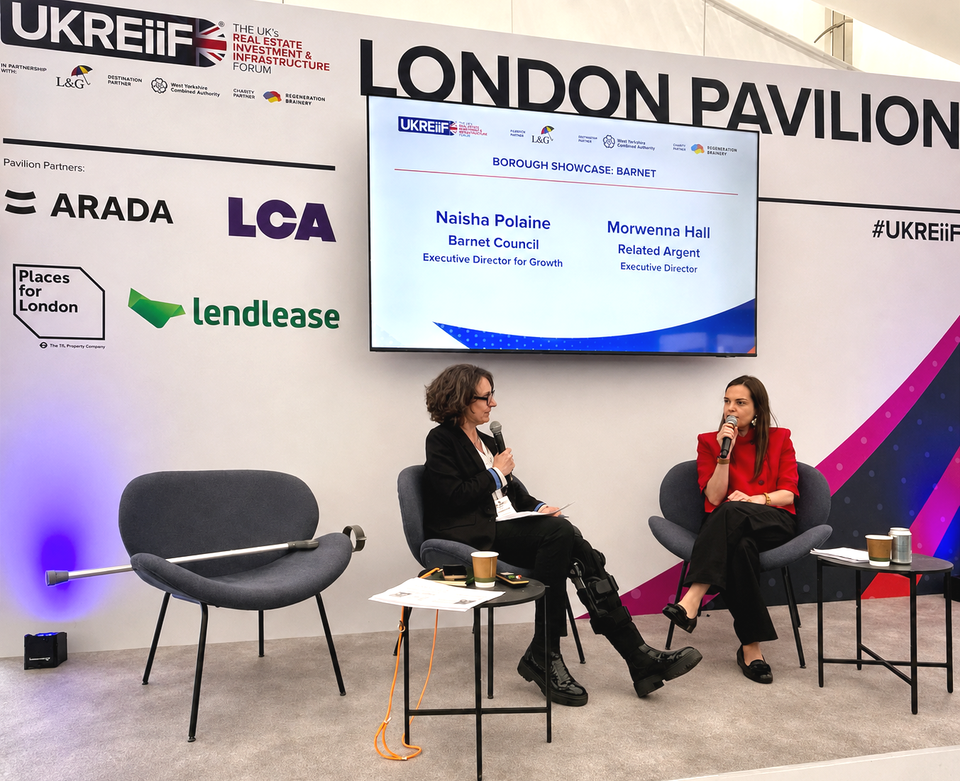
At the “Borough Showcase: Barnet” session, Naisha Polaine, Executive Director for Growth at the London Borough of Barnet, and Morwenna Hall, Executive Director at Related Argent, set out how the borough is approaching one of the largest regeneration agendas in London.
The discussion focused on Barnet’s investment pipeline, its experience of delivering major infrastructure-led regeneration, and the lessons from a decade-long public-private partnership at Brent Cross Town.
For Polaine, the starting point was clear: Barnet sees itself as “the place where London begins.” It is the second-largest borough in London, home to more than 400,000 residents, 25,000 businesses, 30 town centres, 13 tube stations and more than 200 parks and green spaces.
But the borough’s case is not simply one of scale. It is one of delivery.
Barnet has built close to 2,000 homes a year over the past five years and is on track to deliver another 35,000 homes over the next decade. It has the third-largest housing target in London, processes more than 6,000 planning applications a year, and is enabling several of the capital’s most significant regeneration schemes.
That includes Brent Cross Town, Colindale and Edgware Town Centre, projects that together point to a borough positioning itself as one of London’s major growth engines.
Growth built around infrastructure
One of the strongest themes of the session was Barnet’s belief in infrastructure-first regeneration.
At Brent Cross Town, the council and Related Argent have delivered the first new mainline station in London for more than a decade. Brent Cross West is not being treated as an add-on to development, but as a cornerstone of the area’s transformation.
A similar approach is being taken at Colindale, where £30m is being invested in the tube station to support growth in the wider regeneration area.
For Polaine, this is central to Barnet’s offer. The borough is not just allocating land for homes and commercial space. It is trying to put the transport, skills, education and public realm infrastructure in place to support long-term growth.
That matters because Barnet’s development pipeline is substantial. Brent Cross Town alone will deliver:
- 6,700 homes
- Workspace for up to 25,000 people
- Around 50 retail and hospitality spaces
- 50 acres of parks and playing fields
The project is now moving from vision into occupation. First residents are moving in, new buildings are on site, and the place is beginning to shift from a development project into a functioning town.
Brent Cross Town as a test of partnership
Brent Cross Town was the centrepiece of the conversation, not only because of its scale but because of what it says about public-private delivery.
Barnet and Related Argent are now ten years into their joint venture. Hall described the project as very different from King’s Cross, where she spent 15 years, but said the same long-term lessons apply: regeneration is not just about building. It is about operating, adapting and creating a place that people want to use over time.
“With regeneration, it’s not just building, it’s also operating and giving a great experience.”
Morwenna Hall
That operating mindset is important. The hardest part of maintaining momentum over the past decade, Hall said, has been the market. The economic environment has been difficult, and the partnership has had to navigate changing conditions while continuing to deliver.
Her answer was not that partnership removes tension. It was that mature partnerships create the conditions to work through it.
A key distinction, she argued, is between transparency and openness. In a joint venture between public and private organisations, full transparency is not always possible. Both sides have commercial sensitivities, institutional pressures and different responsibilities. But openness, being honest about challenges, needs and constraints, is essential.
That distinction is useful in a market where public-private partnerships are often discussed in abstract terms. Trust is not built by pretending interests are identical. It is built by understanding where they align, where they diverge, and how to keep working when conditions become difficult.
The importance of shared vision
Both speakers returned repeatedly to the importance of a shared vision.
For Polaine, Barnet’s role is to secure long-term outcomes for existing and future residents. That means homes, jobs, transport, green space, skills and public services.
For Related Argent, Hall said success is tied to the idea of a “flourishing town”, a place with a wide mix of people living, working, visiting and using the town in different ways.
That goes beyond unit numbers.
The physical outputs are necessary, but they are not the final test. The real measure will be whether Brent Cross Town supports health, wellbeing, employment, community and everyday life.
This is where large-scale regeneration becomes more complicated. A scheme can be planned, consented, financed and delivered, but at some point it has to be handed over emotionally as well as physically. Residents, workers and visitors begin to form their own views of the place.
Polaine described this as the moment when a project team has to “let go.” Hall agreed, drawing on the experience of King’s Cross. The ability to let go, she said, can itself be a sign of success.
If a place constantly needs to be curated by its developer or public-sector sponsor, it may not yet be resilient. But when communities start to use spaces in their own way, whether through informal chess groups, salsa dancing, local events or everyday routines, the place begins to take on a life of its own.
That is the point at which regeneration becomes less about control and more about stewardship.
High-performing teams communicate constantly
The discussion also touched on what it takes to sustain teams through long regeneration cycles.
Large projects rarely offer quick gratification. They move through planning, infrastructure, procurement, market cycles, construction, political change and public scrutiny. Momentum can be difficult to maintain, particularly in a market where viability, funding and delivery risk are under pressure.
Hall argued that high-performing teams communicate constantly. They do not become fixated on a single fixed version of an outcome, especially in a changing market. Instead, they focus on process, decision-making quality and the ability to adapt.
Polaine added that leadership also requires a human awareness of what teams are going through. Celebrating small wins matters because the next problem is always forming.
That point is easy to overlook in discussions about regeneration, which often focus on capital, planning and delivery structures. But long-term projects depend on people who are willing to commit large parts of their careers to them.
Hall described that commitment as doggedness: the resilience to keep going because the outcome matters.
Youth, skills and opportunity
Questions from the audience brought the conversation back to local communities, particularly young people.
Hall said Brent Cross Town benefits from having three new schools as part of the regeneration project. Related Argent and Barnet are working with schools on participation in the emerging town, but also on employment and skills.
The joint venture has dedicated resources focused on matching local people with jobs created through the project, whether in construction, retail, hospitality or future commercial occupiers.
That includes:
- Work experience
- Internships
- Apprenticeships
- Supply chain opportunities
- Employment and skills programmes
The arrival of Sheffield Hallam University later this year is expected to add another layer, creating higher education opportunities and strengthening the link between regeneration, skills and local economic mobility.
This is an important part of Barnet’s wider growth story. Housing delivery alone is not enough. For regeneration to command long-term public support, it has to create visible routes into employment and opportunity for the communities already there.
Connectivity beyond the red line
Another audience question focused on wider connectivity: the North Circular, the M1, Brent Cross Shopping Centre, blue-green infrastructure and links across the wider area.
Hall said one of Brent Cross Town’s pledges is to strengthen connections, both physical and social. The new station has already changed movement patterns between Barnet and Brent, and the project is now looking at how to improve permeability across the wider area, including connections across the A41.
Polaine added that work around transport changes in the area is imminent, and that the council is in discussions with the owners of Brent Cross Retail Park about future masterplanning.
The point is significant. Regeneration projects can fail when they are treated as isolated islands. Barnet’s challenge is to ensure that Brent Cross Town connects into the existing urban fabric, rather than simply creating a new quarter beside it.
Planning certainty in a changing political environment
The session also addressed the political context in Barnet.
Following recent changes, the borough has no overall control, with a minority Labour administration and Conservative scrutiny. For investors, the obvious question is whether that affects planning certainty and long-term decision-making.
Polaine’s response was that Barnet’s political culture has remained broadly collegiate, with both main parties working in the interests of the borough despite political differences. Brent Cross Town itself has already moved through political change, supported by a cross-party approach.
She also pointed to Barnet’s relatively new local plan, while acknowledging that changes in national policy and the forthcoming London Plan will require further modification.
The borough’s planning function remains one of the busiest in the country, handling around 6,000 applications a year.
The message to investors was that Barnet remains a growth borough, but not one operating in a static policy environment. Like every London borough, it is having to respond to national reform, housing need, viability pressure and evolving regional policy.
Crisis as a call to arms
The mood across the wider market may be cautious, but Hall ended on a note of guarded optimism.
What gives her confidence, she said, is the scale of the crisis itself. Housing, climate and quality-of-place challenges are not going away. That creates responsibility, but also purpose.
The industry still needs to deliver homes, workplaces and places where people can thrive. The current environment is difficult, but the underlying need remains.
For Barnet, that creates both pressure and opportunity. It has some of London’s largest development sites, strong transport connections, major housing targets and established delivery partnerships. But it also has to show that growth can translate into long-term value for residents, businesses and communities.
The borough’s proposition is therefore not just about land or pipeline. It is about credibility: the ability to deliver complex regeneration over many years, through changing markets and political cycles, while keeping public and private partners aligned.
That may be Barnet’s most important investment message.
In a market where many schemes are struggling to move, the borough is arguing that experience, infrastructure and partnership discipline matter as much as ambition.
Key takeaways
- Barnet is already delivering at scale, with close to 2,000 homes built each year over the past five years and a further 35,000 homes planned over the next decade.
- Infrastructure is being treated as the foundation for growth, shown through Brent Cross West station, the Colindale tube station upgrade and wider transport planning around Brent Cross.
- Brent Cross Town is moving from development project to lived-in place, with first residents arriving and the scheme beginning to operate as a real town.
- The Barnet and Related Argent partnership shows the importance of long-term public-private alignment, especially when market conditions are difficult.
- Success will be judged beyond housing numbers, with the focus on creating a flourishing town that supports jobs, wellbeing, community, retail, education and public life.
- Local opportunity is central to the regeneration strategy, through schools, work experience, internships, apprenticeships, supply chain opportunities and future higher education links.
Subscribe to our newsletter.
Become a subscriber receive the latest updates in your inbox.