
UK hotel investment volumes are rising again, but the headline numbers hide a much more selective market. Capital is concentrating around assets where investors can see resilient cash flow, operational upside and a credible route to the next buyer.
On paper, the UK hotel investment market looks considerably healthier than it did a year ago.
Around £2.5 billion of hotels transacted in the first half of 2026, approximately 70% more than during the same period in 2025. More than 85% of that volume came from single-asset transactions.
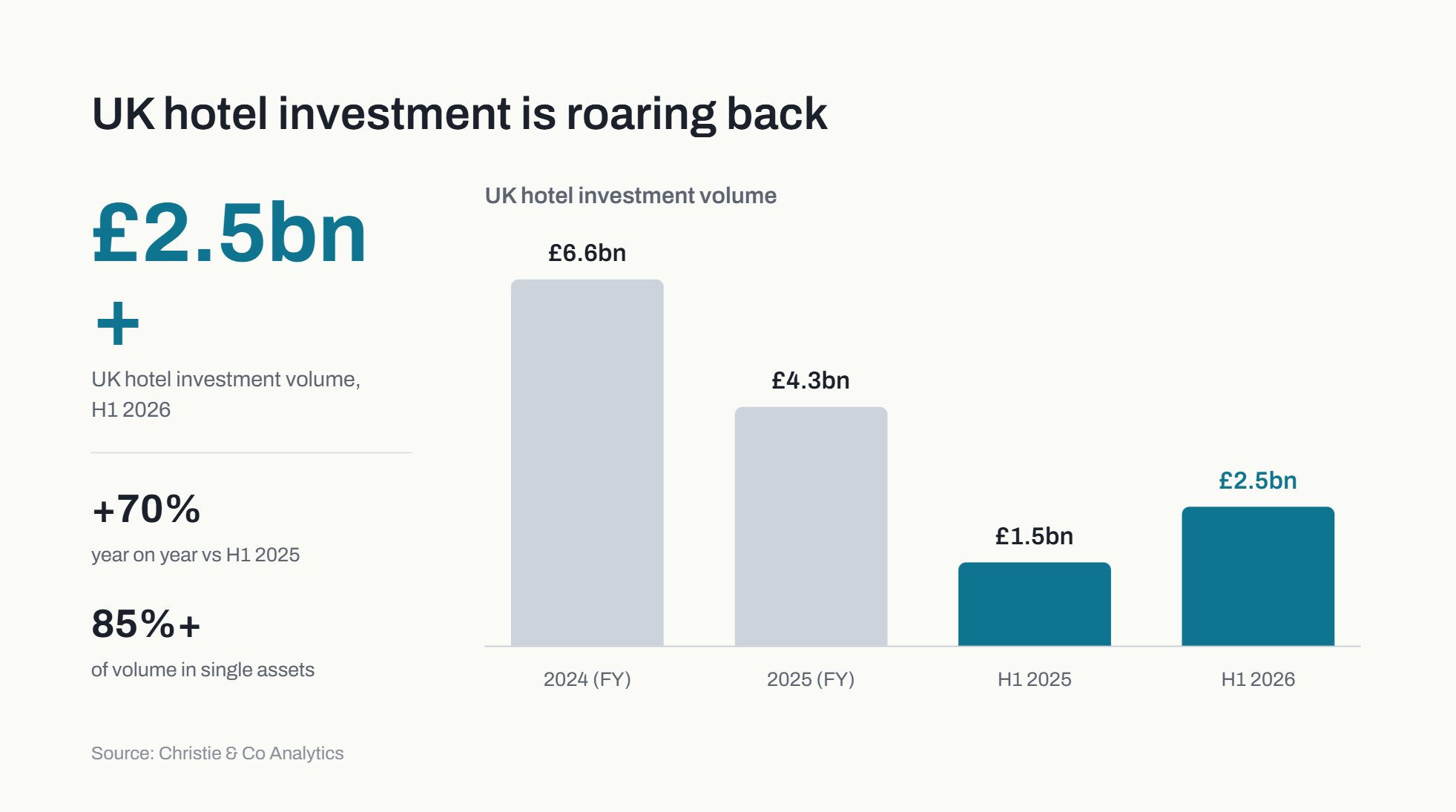
Yet the headline recovery is broader than the market underneath it.
Around three quarters of UK hotel investment volume has been concentrated in London. Even more strikingly, roughly £1.7 billion of the £2.5 billion total came from just ten transactions.
Those deals included The Other House portfolio at £331 million, Hotel Riu Plaza at £287 million, St Giles Hotel at £221 million, Park Plaza Waterloo at £148 million, the London MCR Hotel Portfolio at £123 million, Novotel Tower Bridge at £115 million, Marriott Grosvenor Square at £110 million and Hotel Saint/Leonardo Aldgate at £108 million. Cameron House at Loch Lomond, at around £100 million, was one of the few major deals outside London.
The pattern is difficult to miss. Capital is moving, but it is moving towards assets where investors can see scarcity, demand, liquidity and something they can actively improve.
“The story of 2026 isn’t about recovery. I think it’s about concentration.”
Carine Bonnejean, Christie & Co
That distinction matters because rising transaction volumes do not necessarily mean investors have become comfortable with hotels generally. Instead, they suggest that investors are prepared to act decisively where the investment case is strong enough.
The market is splitting
The strongest activity is appearing at opposite ends of the market.
At one end sit large, high-quality assets in London. They benefit from deep demand, high barriers to entry and a large potential buyer pool. At the other are smaller hotels where private buyers, owner-operators and increasingly buyers from adjacent operational sectors can see a direct route to improving the business.
The difficult area is the middle.
Mid-sized portfolios and hotel platforms can be too large for many entrepreneurial buyers while lacking the scarcity and liquidity of prime institutional assets. Financing can also become more complicated, particularly where substantial capex is required.
Investors can still be comfortable acquiring a £100 million prime London property or a 30-bedroom regional hotel. The space between the two can be much more difficult to transact.
That does not mean regional hotels are unwanted. Manchester, Edinburgh, York, Glasgow, Liverpool and Oxford remain attractive markets. But investors increasingly want strong trading fundamentals, identifiable demand drivers and a clear reason why a particular asset should outperform.
Capital is no longer rewarding exposure alone. It is rewarding specificity.
Buying the market is becoming a weaker investment thesis
For much of the previous property cycle, investors could benefit from several forces at once.
Cheap financing supported acquisitions. Property values generally rose. Yield compression could create returns even before major operational improvements were made.
That environment has changed.
Investors today are underwriting higher labour costs, National Insurance, energy, business rates, brand requirements, compliance expenditure and refinancing risk. Future capex has become a much more important part of due diligence, particularly where property improvement plans or fire and life-safety work are required.
The investment question has therefore shifted. It is no longer enough to ask how quickly revenue can grow. Investors increasingly want to understand how durable the profit underneath that revenue is.
Bonnejean's phrase captures the change well: “Cash flow quality is the new currency.”
That helps explain why a seemingly expensive hotel can still attract capital while a cheaper one struggles.
The first may have predictable demand, strong pricing power, multiple routes to repositioning and few hidden capital requirements. The second may appear inexpensive on a yield basis but require significant investment simply to maintain its current earnings.
Headline yield is becoming less useful without understanding the quality of the business underneath it.
Operational capability is becoming part of underwriting
The implication is that hotel investing is becoming increasingly operational.
An investor needs a view on the market, but also on what can happen inside the building.
Can the hotel attract a different customer mix? Are rooms priced correctly? Can distribution costs be reduced? Is there an opportunity to reposition the brand? Can staffing, procurement or energy consumption be improved? Would a refurbishment actually produce enough additional ADR to justify the capital?
These are no longer secondary asset-management questions. They increasingly determine whether the acquisition works in the first place.
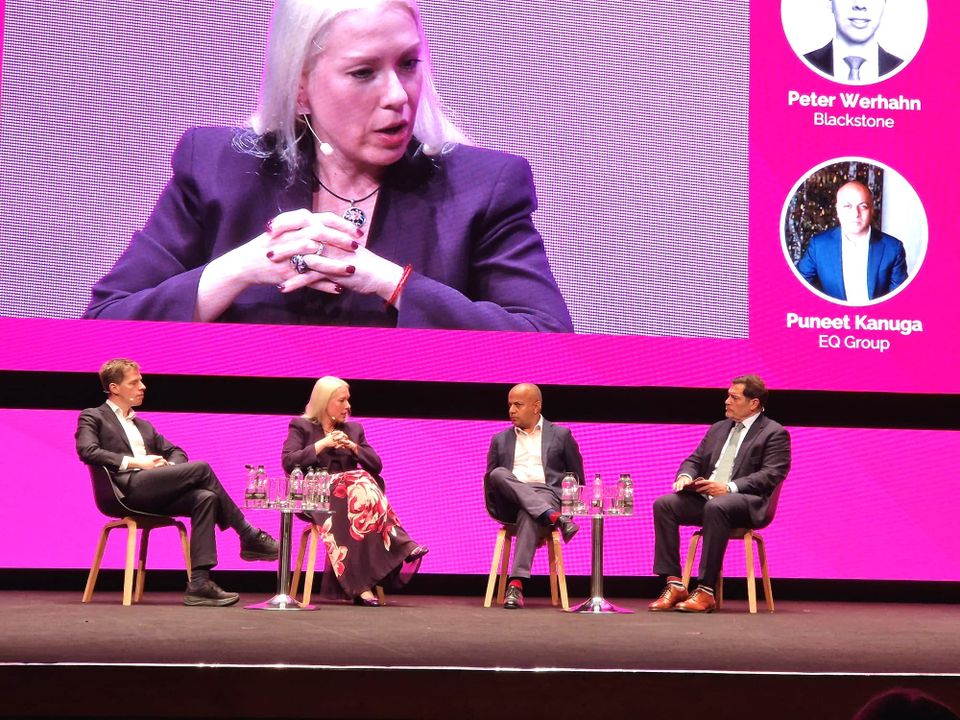
Peter Werhahn of Blackstone argued that investors need to be able to underwrite “value-added business plans” and some form of operational improvement, backed by a team capable of executing them.
This demands more than access to capital. It requires an operating thesis.
“You’ve got to find value in today’s market. It’s not staring you in the face, you’ve got to go and engineer and unlock complexity.”
Puneet Kanuga, EQ Group
That may be one of the defining ideas of the current cycle.
The opportunity is still there. It has simply moved deeper into the asset.
Value can be created before the refurbishment begins
EQ Group's experience with an 18-hotel portfolio offers a useful example of how that works.
One of the portfolio's largest assets was a hotel in Hammersmith. Instead of immediately undertaking a major customer-facing refurbishment, the strategy began with segmentation.
The existing customer mix was effectively discarded as an assumption. The question became: if the hotel were being positioned today from a blank sheet of paper, what should its market mix actually look like?
That produced a substantial change in performance.
During a period when the surrounding submarket increased by only around 0.7%, the hotel's performance increased by approximately 15.4%. NOI rose by around 49%.
At the same time, a larger redevelopment plan was being prepared to reposition the property as a major London meetings and events hotel.
But the redevelopment was never needed to prove the investment case.
A buyer arrived before the full capex programme had been executed. The existing earnings had improved, while the next phase of the business plan gave the buyer a visible route to further value creation.
Across the wider portfolio, NOI increased by around 20% without major front-facing capex. EQ ultimately achieved what it had originally expected to be its year-five money multiple in approximately 27 months and exited the assets.
The lesson is not that refurbishment is unimportant. It is that capex is only one way to create value.
Sometimes better segmentation, stronger revenue management, a clearer commercial strategy and tighter operating discipline can materially change an asset before the first major renovation begins.
A good investment leaves something for the next buyer
There is another important idea in that example.
EQ sold before exhausting all of the upside.
At first, that might appear counterintuitive. Why sell an asset if further redevelopment and earnings growth remain available?
Because a strong exit does not require the seller to capture every pound of potential value. The next buyer needs a reason to buy.
A hotel becomes more liquid when the purchaser can see both what has already been achieved and what remains possible.
This creates a useful distinction between maximising an asset and making it investable.
A perfectly optimised hotel may generate strong cash flow, but if there is little left for the next owner to improve, the acquisition thesis can become less obvious.
The most liquid assets often provide both evidence and optionality.
Exit preparation starts much earlier than the sale
The same thinking applies beyond the operating P&L.
EQ upgraded fire and safety standards across its portfolio, improved EPC ratings from D, E and F levels to B ratings, and reorganised the portfolio so that individual hotels could be sold separately.
None of these measures necessarily creates an immediate increase in room rate.
But they reduce friction.
A future buyer has fewer compliance problems to solve. Institutional capital can underwrite the asset more easily. Financing may be easier to obtain. Individual hotels can be sold without restructuring the entire portfolio.
This expands the definition of value creation.
Increasing NOI matters, but so does increasing the number of buyers capable of underwriting that NOI.
Liquidity itself can be engineered.
Hotels have one important advantage in a higher-rate world
Despite a difficult macroeconomic environment, hospitality retains one characteristic that distinguishes it from more static forms of real estate.
Hotel rooms are repriced constantly.
An office landlord may wait years for a lease event before being able to capture higher market rents. A hotel can change tomorrow's rate this afternoon.
That gives operators far more control over the top line and potentially more flexibility in an inflationary environment.
Werhahn pointed to this directly, noting that in hospitality, “we control our P&L” and can set pricing on a daily basis.
That flexibility helps explain why institutional interest in hotels and other operational real estate remains strong despite higher interest rates.
But it also makes operational capability more important.
A hotel may have greater potential to respond to demand than an office building, but someone still has to make the right pricing, distribution, staffing and positioning decisions.
Flexibility has value only when it is used well.
Investors are learning to underwrite uncertainty rather than wait for it to disappear
The temptation in an uncertain market is to wait.
Wait for interest rates to fall. Wait for inflation to stabilise. Wait for geopolitical risks to ease. Wait for sellers to reduce expectations.
But waiting for every variable to improve is not necessarily a strategy.
The stronger approach is to distinguish between factors an investor can control and those it cannot.
“We have to completely cut through this short-term noise and fluctuations, and look at the long-term impact.”
Natalia Kolotneva, LaSalle
That reflects a wider shift in underwriting.
An investment case should not depend on a particular geopolitical outcome or perfect macroeconomic conditions. If rates fall or the economy improves, that can create additional upside. But the underlying business plan still needs to work without it.
Blackstone described a similar philosophy, arguing that business plans should not rely on any particular geopolitical outcome.
This is perhaps a better definition of conviction than simple optimism.
Conviction is not the belief that everything will go right. It is the belief that enough remains within your control if it does not.
Leisure remains a long-term structural theme
The current selectivity does not mean investors have lost confidence in travel itself.
Consumer demand has remained resilient through inflation, geopolitical uncertainty and repeated increases in travel costs.
Leisure, broadly defined, remains part of the long-term investment case. That includes traditional leisure travel but also the growing importance of experiences, health, fitness, outdoor activity and wellness within hospitality.
At the same time, new hotel supply remains constrained in many markets, creating potentially favourable supply-demand dynamics for well-positioned existing assets.
That does not make every hotel attractive.
It makes the distinction between the right hotel and the wrong hotel more important.
The next phase of the market will be unlocked asset by asset
A broader recovery will still require several things to align.
More owners need a genuine reason to sell, whether because an investment cycle has reached its natural end, refinancing is approaching or significant capex is required.
Buyers and sellers also need to reach a realistic view of earnings, future expenditure and risk.
Finally, financing conditions need to work, particularly for the middle of the market where liquidity remains weaker.
But the more interesting change may already have happened.
Hotel investment is becoming less dependent on the market lifting all assets together.
Instead, value is increasingly being created one hotel at a time.
That favours buyers who understand operations, owners who can demonstrate the resilience of their cash flow and assets where there is more than one credible route to improvement.
The question is therefore changing.
It is no longer simply: How much will this hotel be worth when the market improves?
Increasingly, it is: What can we change so that this hotel becomes more valuable even if the market does not?
Key takeaways
- The recovery is concentrated. Around £2.5 billion of UK hotels traded in H1 2026, but roughly £1.7 billion came from only ten transactions, with London accounting for around three quarters of total volume.
- Capital is available, but much more selective. Investors are prioritising assets with strong demand, resilient cash flow, liquidity and a clear value-creation story.
- Operational capability is becoming part of underwriting. Pricing, segmentation, cost control and positioning increasingly determine whether a deal works.
- Capex is not the only route to value creation. Significant NOI growth can sometimes be achieved before major refurbishment through better commercial and operational decisions.
- The next buyer matters from day one. Compliance, EPCs, asset structure and remaining upside can materially affect future liquidity.
- Conviction now means control. The strongest investment cases are those that can work without relying on falling rates, improving valuations or a perfect macroeconomic backdrop.
Subscribe to our newsletter.
Become a subscriber receive the latest updates in your inbox.